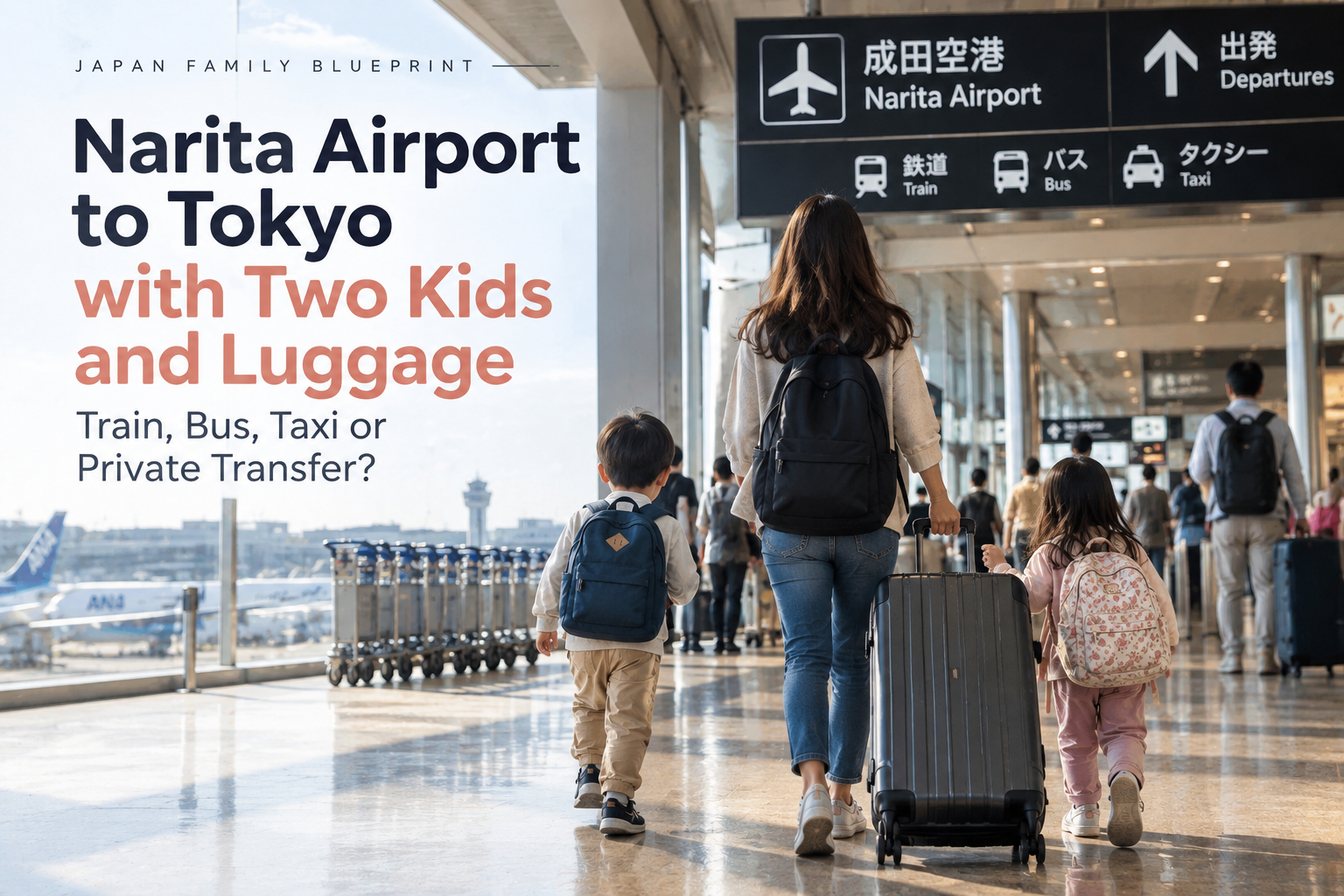
Traveling from Narita Airport to Tokyo with two young kids and a few suitcases can look surprisingly simple when you’re planning the trip at home.
The Narita Express is fast. The Skyliner is fast. Buses can be cheaper. A private transfer is easy, but expensive.
Then you actually arrive with tired children, luggage, maybe a stroller, and a hotel that isn’t right next to the station.
That’s when the “fastest” route on Google Maps can stop being the easiest one.
I live in Chiba Prefecture and travel around Japan with two young children. I’ve taken trains with a stroller and luggage, driven around Narita and Tokyo, and dealt with the very normal problem of trying to move children through a station when they don’t move at adult speed.
So if I were arriving at Narita with my own two kids and two or three suitcases, I wouldn’t choose based on travel time alone.
I’d look at where the hotel actually is, how many times we have to transfer, how far we have to walk after getting off, and how much energy I’m likely to have left after the flight.
Here’s how I would compare the main options.
Last checked: September 16, 2026. Fares, schedules and routes can change, so please check the operator’s latest information before you travel.
Quick answer: Which option should you choose?
If you don’t want to read the whole guide before narrowing down your options, this is where I would start:
| If you’re… | I’d check this first |
|---|---|
| Staying close to Tokyo, Shibuya or Shinjuku Station | Narita Express (N’EX) |
| Staying around Ueno or Nippori | Keisei Skyliner |
| Staying at a hotel served directly by an airport bus | Airport bus |
| Traveling with two young kids, several bags and an awkward final connection | Private transfer |
| Mainly trying to keep the cost down | Bus or train |
| Arriving exhausted after a long flight | Airport bus or private transfer |
There isn’t one option that’s best for every family.
The part I would pay the most attention to is what happens after you get off the airport train or bus.
Don’t compare Narita Airport to the nearest major station.
Compare Narita Airport to your hotel.
Narita Express: Best when your hotel is near a direct stop
The Narita Express, usually called N’EX, runs directly from Narita Airport to major stations including Tokyo, Shinagawa, Shibuya and Shinjuku.
As of September 2026, an ordinary-car ticket from Narita Airport costs ¥3,140 to Tokyo and ¥3,330 to Shibuya or Shinjuku.
There is also an N’EX TOKYO Round Trip Ticket for eligible travelers. It currently costs ¥5,200 for adults and ¥2,600 for children aged 6–11 and can be used for a round trip within 14 days.
N’EX has space for large luggage, and you can reserve seats in advance.
For a family, those things matter.
What N’EX was like with my own kids
I’ve ridden the Narita Express with my children between Sakura and Tokyo.
To be clear, I wasn’t traveling from Narita Airport on that trip, so I can’t tell you what the airport boarding experience was like from personal experience.
But I can tell you what being on the train with my children was like.
We could sit together, we had somewhere to put our luggage, and the kids were perfectly happy watching the view outside. We traveled at a relatively quiet time, so the ride itself was comfortable.
I also liked the front row because it felt a little more open. Sitting at the back of a row can be convenient too, especially if you’re the kind of person who worries about reclining your seat into someone else’s space.
Honestly, the train itself isn’t the part I would worry about.
It’s what comes after it.
When I would — and wouldn’t — choose N’EX
If I got off at Tokyo or Shinjuku and my hotel was a short, straightforward walk away, N’EX would be high on my list.
If I still had to change to a local train with two children, a stroller and three suitcases, I would think about it very differently.
A route can look easy when you only see “Narita Airport → Tokyo Station.”
Add another train, a large station and a final walk to the hotel, and it’s a different journey.
Skyliner: A strong choice for Ueno and Nippori
The Keisei Skyliner is the other obvious train option from Narita.
It’s especially useful if you’re staying around Ueno or Nippori.
The standard one-way fare is currently ¥2,580 for an adult and ¥1,290 for a child aged 6–11, and all seats are reserved. The fastest service from Narita Airport Terminal 2・3 to Nippori takes 36 minutes.
On paper, that’s excellent.
But again, I would open the map and look at what happens after Nippori or Ueno.
If the hotel is nearby, great.
If Google Maps then shows another train, a station change and a walk at the end, I wouldn’t automatically choose the Skyliner just because the first part of the journey is fast.
This is one of those situations where ten minutes saved on a train can easily be lost again while you’re trying to find an elevator with a stroller.
Don’t overlook the airport bus
Before traveling with children, I probably would have focused much more on the trains.
With children, I think buses deserve a closer look.
If an airport bus stops directly at your hotel, or close enough that you can easily walk from the stop, that’s a big advantage.
You put the luggage underneath the bus, sit down with the kids and don’t have to drag everything through a huge station when you arrive in Tokyo.
The downside is traffic
I live in Chiba and drive around the Narita area, and road conditions aren’t always predictable. Weekends in particular can be frustrating.
So I wouldn’t choose a bus because a timetable says it will take a certain number of minutes.
I would choose it because of where it drops me off.
If the choice were a slightly longer bus ride that left us near the hotel or a faster train followed by a difficult transfer, I could very easily choose the bus.
When a taxi or private transfer starts to make sense
This is the option that can look ridiculous when you compare prices.
Narita Airport’s current fixed-fare taxi rates are around ¥29,000–¥31,000 for areas including Chuo and Chiyoda, and ¥31,500–¥32,500 for areas including Shinjuku and Shibuya. Expressway tolls and other applicable charges are additional.
Compared with a train ticket, that’s a lot of money.
I wouldn’t pretend otherwise.
But after traveling abroad with my own children, I understand the appeal much more than I used to.
A private transfer made more sense to me after Hong Kong
On a recent trip to Hong Kong, I was the foreign visitor.
I didn’t know the area. I had children with me. We had luggage. I wasn’t completely sure how easy the public transport journey would actually be once we arrived.
So I booked a private transfer.
I definitely noticed the price.
But once we arrived, I didn’t have to work anything out. We got in the vehicle and went where we needed to go.
What I had paid for wasn’t really transportation.
It was certainty.
That experience changed how I think about families arriving in Japan.
After a long international flight, you’re asking a parent to navigate a country they don’t know, possibly in a language they don’t speak, while keeping track of their children and luggage at the same time.
Sometimes spending more to remove all of that is completely reasonable.
Check the vehicle size before booking
One thing I would check before booking is the vehicle size.
Two adults and two children may fit easily, but two or three large suitcases plus a stroller can change things quickly.
Don’t assume every standard taxi will have enough luggage space. If you’re pre-booking a transfer, check the luggage allowance and vehicle capacity before paying.
The part people forget: Getting from the station to the hotel
This is the part I would check before booking anything.
I’ve taken Japanese trains with children, a stroller and luggage. One trip to Ueno Zoo is a good example.
The train ride itself wasn’t particularly difficult.
The transfer was.
Stations can involve much more walking than you expect. With a stroller, you can’t always use the most obvious staircase or escalator, so you may need to find an elevator instead.
Then there’s the older child who can’t walk as fast as an adult, the stroller, the bags and the pressure of trying to work out where you’re going while people are moving around you.
And trains that are comfortable at one point in the journey can become much busier as you get closer to central Tokyo.
I’ve also traveled during busy commuting periods with children. I wouldn’t deliberately plan my first journey in Japan around doing that with a stroller and several suitcases if I had another sensible option.
It isn’t that children or strollers can’t use Japanese trains. Of course they can.
It’s simply much easier when you’re not trying to manage everything at once.
A “5-minute walk” doesn’t always feel like five minutes
This also affects how I choose hotels.
Personally, when I’m traveling with young children and luggage, I like the station to be around five to seven minutes away at most.
That’s not a rule everyone needs to follow. It’s just the point where I start thinking carefully about whether the hotel is actually convenient for us.
A “five-minute walk from the station” assumes you know where you’re going.
On your first day in Japan, you may need to find the correct exit first. Then the elevator. Then work out which direction you’re walking.
Add a stroller, suitcases and a child who suddenly decides they don’t want to walk anymore, and that five minutes can feel very different.
So when you’re comparing airport transport, don’t stop looking at the route when you reach Tokyo Station, Shinjuku or Ueno.
Zoom all the way in to your hotel.
What I would actually choose with my two kids
If I landed at Narita tomorrow with my own two young children and two or three suitcases, I would start with the hotel location rather than the transport.
Hotel close to Tokyo, Shibuya or Shinjuku Station
I’d check N’EX first.
Reserved seats, luggage space and a direct journey make a lot of sense if the final walk is easy.
Hotel around Ueno or Nippori
I’d check the Skyliner first.
If the hotel is genuinely convenient from Ueno or Nippori, its speed makes it a very attractive option.
Airport bus stops at or near the hotel
That immediately becomes interesting.
Avoiding a station transfer with children and luggage is worth something to me, even if the journey itself takes a little longer.
Another local train is required after the airport train
That’s when I start comparing a private transfer.
I would also look at our arrival time. A route I might happily take in the middle of the day could be something I’d rather avoid during the evening rush.
And if we’d just finished a long flight and I knew both kids would be exhausted, convenience would matter more to me than saving every possible yen.
Before you book, look at the whole route
Open your hotel in Google Maps and look at the whole route from Narita Airport.
Not just the airport train.
Check where you get off. Check whether you have to transfer. Look at the walking distance. If you’re bringing a stroller, remember that the elevator route through a station may not be the shortest route shown on your phone.
Then look at your luggage.
And finally, imagine doing that exact journey while one child is tired and the other one suddenly needs the toilet.
If the route still looks manageable, great.
If it suddenly looks awful, that’s useful information too.
The fastest train isn’t always the easiest family journey.
Frequently Asked Questions
Is the Narita Express good with young kids?
Yes, it can be a very practical option. You can reserve seats, there is dedicated luggage space, and N’EX runs directly to major stations including Tokyo, Shibuya and Shinjuku.
I would pay just as much attention to the journey from that station to your hotel, though. A difficult final connection can change whether N’EX is actually the easiest option for your family.
Is N’EX or the Skyliner better for families?
It depends mainly on where you’re staying.
I would generally look at N’EX for Tokyo, Shibuya or Shinjuku and the Skyliner for Ueno or Nippori.
If either option leaves you with a difficult transfer afterward, that may change the answer.
Can you take a stroller on trains in Japan?
Yes. I use trains with my children and a stroller myself.
The harder part is often navigating large stations, finding elevators and managing transfers when you also have luggage. If possible, I would avoid making your first airport transfer during the busiest commuting periods.
Is a private transfer from Narita worth the money?
For some families, absolutely.
I would consider one if I had several large bags, two tired young children, a difficult final train connection or a late arrival after a long flight.
It’s much more expensive than the train, but you’re paying for a door-to-door journey and much less to figure out when you arrive.
How close should a Tokyo hotel be to the station with young kids?
There isn’t one correct answer.
My personal preference when I have young children and luggage is roughly five to seven minutes or less.
Just remember that the walking time shown online may not include the extra time you spend finding exits and elevators in an unfamiliar station.
One last thing
Getting from Narita Airport to Tokyo isn’t particularly difficult.
Doing it for the first time with two young children, several suitcases, a stroller and very little energy left is a different question.
That’s why I wouldn’t book a transfer based only on the cheapest fare or shortest journey time.
I’d look at the whole trip:
Narita Airport → transport → final stop → hotel.
The easiest option for your family may not be the fastest one on the screen, and that’s completely fine.
Disclosure: Some links on this page may be affiliate links. If you book through them, we may earn a commission at no additional cost to you. We only recommend options that are relevant to the family travel decisions discussed in this guide.