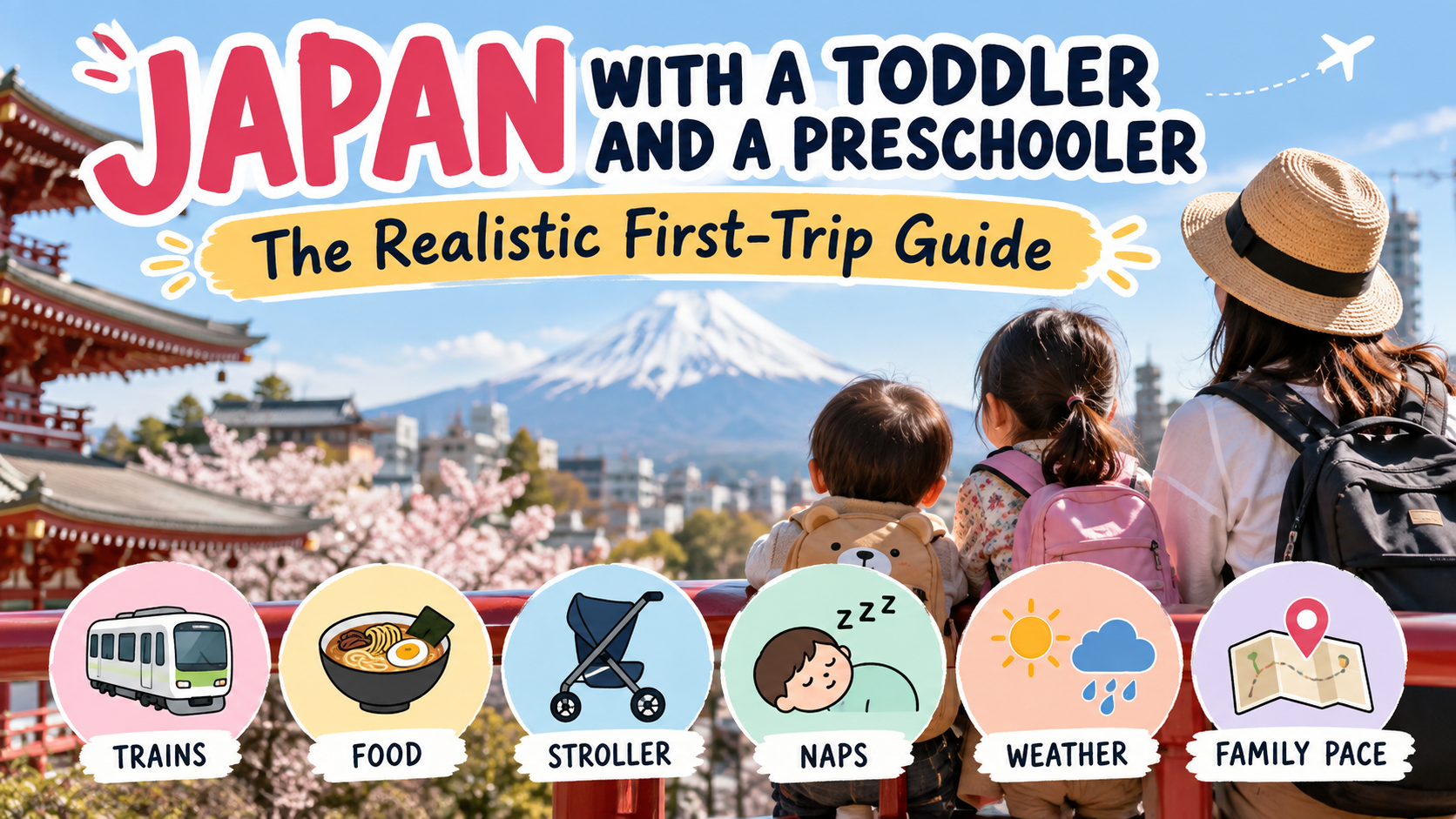
Japan can look surprisingly small on a map.
That can make it tempting to build an ambitious itinerary: Tokyo today, another city tomorrow, several famous neighborhoods in one day, and every meal at a restaurant you saved before the trip.
With a toddler and a preschooler, I would plan very differently.
I live in Japan and regularly travel around with two young children. And after traveling overseas with my own kids, I understand the other side too: unfamiliar transportation, unfamiliar food, a language you may not speak, and the constant thought of, “What if something goes wrong?”
My biggest advice is simple:
Your itinerary should have more empty space than you think you need.
A child cannot move through Japan at an adult’s pace—and your trip will usually be better when you stop expecting them to.
How Much Should You Plan Each Day?
With young children, I would usually plan one main activity per day if it requires significant travel.
If everything is in the same area, one activity in the morning and another in the afternoon may work.
What I would not do is build a schedule that depends on everything going perfectly.
Children suddenly need the toilet.
Lunch takes longer than expected.
Someone refuses to walk.
A child who normally naps at the same time every day suddenly does not sleep because everything around them is exciting.
Then, at 5 p.m., they are exhausted.
One main plan that actually happens is better than four plans your family is too exhausted to enjoy.
Avoid Rush Hour When You Can
Japan’s rail network is extremely useful, but traveling with two little kids, luggage and a stroller is very different from traveling as two adults.
When possible, I avoid the busiest commuting periods.
I also give myself more transfer time than a route planner says I need.
Adults can walk quickly through a station, change direction immediately and hurry for a train.
Young children cannot.
With a stroller, you may also need to find an elevator instead of simply taking the nearest stairs or escalator.
So when planning a route, I would not ask only:
“How many minutes does this train take?”
I would also ask:
“How difficult is the entire journey for my family?”
For airport-specific transportation decisions, see our guides to Narita Airport and Haneda Airport.
Should You Bring a Stroller to Japan?
For a child who still naps or may struggle with long walking days, I think a stroller can be extremely useful.
For my own family, once a child is around four or older, I generally would not consider it essential. But that is a personal benchmark, not a rule.
Your child’s stamina, development and itinerary matter more than age alone.
There is also another benefit: a stroller can help carry some of the things young children inevitably accumulate during a day out.
The downside is that busy trains, narrow shops and complicated stations can make a stroller inconvenient.
So I would think of it as a trade-off:
You gain a place for a tired child to rest, but you lose some mobility in crowded or narrow places.
Food Is Usually Manageable—but Keep a Backup Plan
Food is one area where I generally do not find traveling with children in Japan especially difficult.
There are restaurants, convenience stores, family restaurants and food courts almost everywhere in major cities.
But not every restaurant is designed for young children.
Traditional restaurants, small specialty restaurants and more formal or expensive restaurants may have fewer child-friendly options.
When I travel with my kids, I also find simple things useful: disposable bibs and alcohol-free wet wipes can save clothes, hands and a lot of unnecessary stress.
And I would not put pressure on your family to eat Japanese food at every meal.
I learned this from traveling abroad myself.
There were foods I expected to enjoy but simply did not. Eventually, I found myself choosing familiar, simple food—and yes, even McDonald’s.
That was fine.
Your child eating something familiar after a difficult day does not make the trip less meaningful.
Sometimes the best family travel decision is simply making sure everyone eats.
Can You Buy Diapers and Baby Supplies in Japan?
In major urban areas, many everyday baby and child supplies can be purchased at drugstores and children’s retailers.
But I would not arrive completely empty-handed.
Large children’s stores are not always located beside the major tourist attractions, and small city drugstores may have a more limited selection.
If your child has sensitive skin, I would bring enough of your usual diapers and skincare products to give yourself a buffer.
If your child drinks a particular formula, bringing a familiar travel-friendly supply can also reduce uncertainty. Check airline and airport security requirements for liquids and baby food before flying.
For an emergency purchase, I would look for a drugstore.
For children’s clothes, stores such as Nishimatsuya or Birthday can be useful when one is convenient to your route.
For inexpensive disposable items, Japan’s 100-yen shops can also be helpful.
Baby Rooms Can Make Japan Much Easier
One thing I appreciate about going out with children in Japan is the family facilities available in many larger commercial buildings.
Shopping malls and department stores may have baby rooms, diaper-changing areas, children’s toilets and other parent-friendly facilities. JNTO also notes that nursing rooms can be found in places such as department stores, stations and malls, with some providing facilities such as hot-water dispensers and microwaves for baby food.
But do not assume every location will have everything you need.
At extremely busy attractions, even good facilities can become crowded.
I would still give yourself extra time for toilet and diaper stops instead of waiting until they become urgent.
Japan Is Not Always Stroller-Friendly
Japan has many family-friendly facilities.
That does not mean every place is easy with a stroller.
Some shops—especially densely packed variety or discount stores—can have very narrow aisles.
Even without a stroller, it can be surprisingly easy to lose sight of a small child in a crowded store.
I also find that convenient places to simply sit and rest are not always available exactly when you need one.
This is another reason I would avoid filling every hour of the day.
Your family may need an unscheduled break.
Don’t Build Your Day Around Nap Time Too Strictly
If your child sleeps in a stroller, that can make sightseeing much easier.
But travel is exciting.
A child who normally sleeps at a predictable time may suddenly stay awake much longer.
I prefer to respond to the day rather than fight too hard to preserve the perfect schedule.
If my child looks ready to sleep and I notice a comfortable cafe, I may stop.
The child can rest, and the adults can have a drink or dessert.
That is not wasted travel time.
Sometimes those unplanned quiet moments become part of the trip you remember.
Rainy Days and Japanese Summers Need a Backup Plan
With young children, I would always have an indoor alternative.
Rain means umbrellas, wetter clothes, more luggage to manage and fewer free hands.
Summer deserves even more planning.
Japan’s summer can be very hot and humid, and official tourism guidance recommends precautions including regular hydration during hot weather.
With toddlers or preschoolers, I would not plan an entire summer day outdoors.
Mix outdoor sightseeing with air-conditioned indoor stops, drink regularly and give children more breaks than you think they need.
A portable fan can be useful for comfort, but it should not replace hydration, shade and cooling breaks.
What Happens When Your Child Has Had Enough?
This matters more than almost any itinerary hack.
Sometimes I abandon the plan.
If I only wanted to browse a shop or see something optional, I can skip it.
If I have a restaurant reservation or something that cannot easily be changed, I assess how the child is doing and adjust.
And if the hotel is too far away to return immediately?
I look for somewhere to stop.
Have a drink.
Get a dessert.
Sit down.
If the child falls asleep, the adults might even get a quiet cafe break.
Changing the plan is not failing the trip.
It is often what allows the rest of the trip to stay enjoyable.
Give Your Kids a Version of Japan They Can Enjoy
Adults and young children do not necessarily want the same version of Japan.
Parents may dream about famous neighborhoods, temples and restaurants.
Young children may be much happier somewhere they can actually participate.
Experiences where children can play while discovering Japanese culture can therefore be worth adding to the itinerary.
Rather than filling every day with places adults feel they “should” see, I would mix famous sightseeing with experiences chosen specifically for the children.
They came to Japan too.
Language Is Worth Preparing for Before You Arrive
When I traveled overseas with my children, the language barrier was one of my biggest sources of anxiety.
I could sometimes understand the general idea of what someone was saying, but that is very different from confidently understanding everything when you need help.
I would not assume everyone you meet in Japan will be comfortable communicating in English.
Have a translation app ready before arrival.
Save important hotel information.
Keep addresses available in Japanese when possible.
And make sure both adults can access important travel information instead of storing everything on one person’s phone.
Prepare for the Question Nobody Wants to Think About: What If My Child Gets Sick?
This was another thing I worried about when traveling abroad with my children.
What happens if we suddenly need a hospital?
You do not need to spend the trip worrying about it, but I do think it is worth preparing before departure.
Japan’s Ministry of Health, Labour and Welfare and Japan Tourism Agency maintain information on medical institutions that accept foreign patients. The information can be searched using factors including location, available languages and medical specialty.
Japan also provides multilingual materials intended to support communication with foreign patients in medical settings.
Save the relevant official medical information before your trip and check your travel insurance coverage.
Hopefully you never need either.
But if your child becomes ill, that is not the moment you want to begin researching everything from zero.
Don’t Underestimate Travel Distances in Japan
Japan looks small beside many countries.
That does not mean everything is close.
Even within Tokyo, moving between neighborhoods can consume a surprising amount of the day once you include walking, finding platforms, waiting for elevators, toilet breaks and children moving at their own pace.
And traveling between major regions is another level entirely.
I would not design a first family trip around constantly changing cities simply because Japan’s trains are fast.
A fast train does not eliminate packing, checking out, reaching the station, navigating with children and checking into another hotel.
A child cannot move through Japan at an adult’s pace.
Build the trip around that reality.
Where you stay can also change how tiring each day feels. See our guide to choosing where to stay in Tokyo with young kids before booking your hotel.
A More Realistic First-Trip Rhythm
Instead of asking, “How much of Japan can we fit into this trip?”, I would ask:
“How much can we enjoy without exhausting everyone?”
For a Tokyo day, that might mean one major attraction plus an optional activity nearby.
For another day, it might mean a cultural experience followed by a relaxed afternoon.
A Disney day can simply be a Disney day.
A rainy day can become an indoor day.
And a child who desperately needs to stop can change the plan.
That flexibility is not poor planning.
The flexibility is part of the plan.
Final Advice
There will probably be many places you want to see in Japan.
You will not see all of them.
That is okay.
Leave more time than you think you need.
Avoid building days that depend on perfect train connections, perfect naps and perfectly cooperative children.
Know where your family can eat.
Have a backup for rain and extreme heat.
Prepare for language and medical problems before you need help.
And remember:
Your goal is not to complete Japan. Your goal is to enjoy Japan together.
A slower trip that your children can actually enjoy is better than an impressive itinerary that leaves the entire family exhausted.
FAQ
Is Japan easy to travel around with toddlers?
Japan has excellent transportation and many useful family facilities, but young children change the practical experience. Crowded trains, large stations, walking distances and limited rest opportunities can make an otherwise simple route more demanding.
Do I need a stroller in Japan?
It depends on your child. A stroller can be very useful for children who nap or struggle with long walking days, but it can be inconvenient on crowded trains and inside narrow shops.
Can I buy diapers in Japan?
Yes, diapers and many common baby supplies are widely available, especially in drugstores and children’s retailers. If your child has sensitive skin or requires a specific product, bring enough familiar supplies for at least the beginning of your trip.
How many activities should I plan per day with young kids?
For my family, I would generally plan one main activity when significant travel is involved. If two activities are close together, morning and afternoon plans can work—but I would keep at least one of them flexible.
What should I do if my child gets sick in Japan?
Know where to find official medical information before your trip. Japan maintains information about medical institutions accepting foreign patients, including language and specialty information.
Disclosure: Some links on this page may be affiliate links. If you book through them, we may earn a commission at no additional cost to you. We only recommend options that are relevant to the family travel decisions discussed in this guide.
Last checked: September 26, 2026. Transportation, facilities, store services and medical-support information can change. Always confirm current information with the relevant official source before traveling.